Tue, 30 Jun 2026
|DHIVEHI


Advertisement
A year of decisive reform and public engagement defines 2025
05 Jan 2026
|
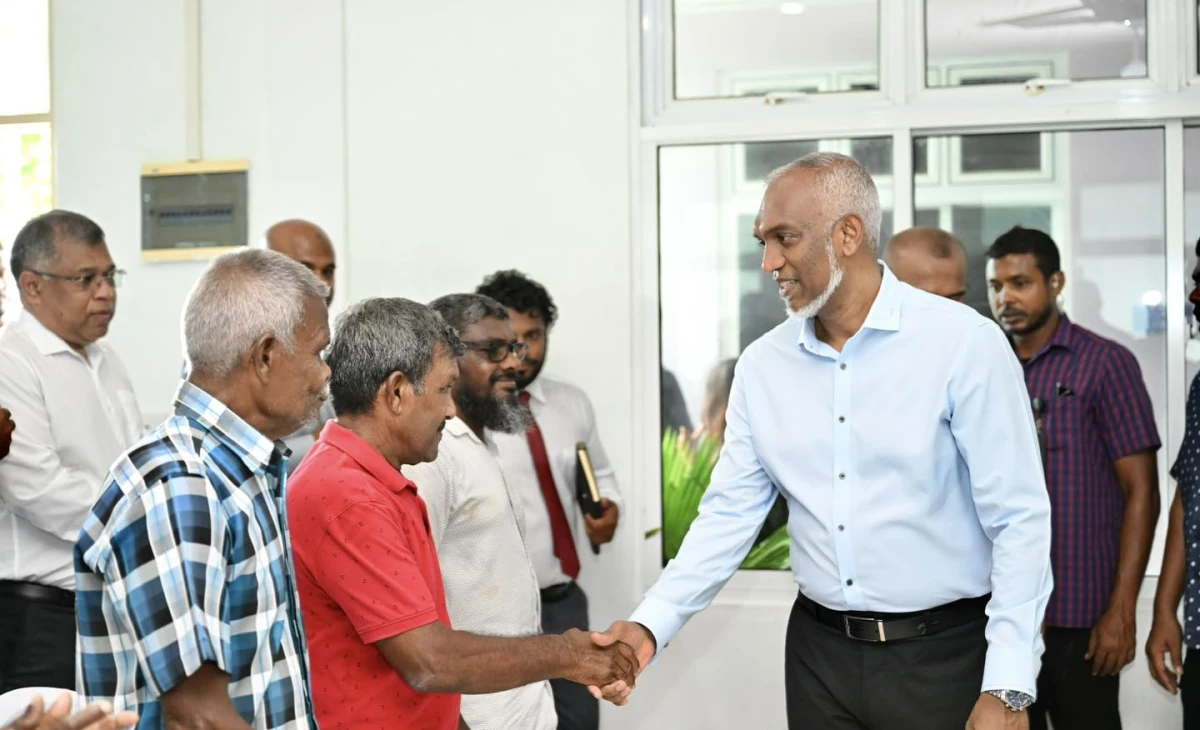
President Dr Mohamed Muizzu meets residents --- Photo: President's Office
2025 stood out as a period of decisive reform, renewed public engagement, and a clear shift in national direction. It was a year in which long-standing challenges were confronted and foundations laid for sustained development.
The year began with the implementation of major financial reforms initiated under the leadership of President Dr Mohamed Muizzu. Introduced at the start of 2025, the reforms required foreign-currency-earning businesses to deposit earnings into local banks, strengthening the domestic financial system and improving foreign exchange management. The policy led to a marked increase in foreign currency inflows and strengthened official reserves, which stood at around USD 800 million by the end of the year, with usable reserves of USD 197 million.
The fisheries sector, which had struggled in previously, began to recover following the introduction of a guaranteed 48-hour payment system for fishermen. Throughout 2025, fish catch volumes increased, exports expanded, fuel prices for fishermen were reduced, and work began on fuel sheds and pump stations across the islands to support the industry’s long-term stability.
On the international stage, the Maldives drew global attention on 15 April 2025 by banning entry for holders of Israeli passports, in response to ongoing humanitarian violations against Palestinians. The move was widely recognised as a principled stance, earning praise from Palestinian leaders, international civil societies, and across the Islamic world.
Another milestone came with the introduction of a generational ban on tobacco, prohibiting the sale of tobacco products to individuals born on or after 1 January 2007. Coming into effect in November 2025, the law positioned the Maldives among global leaders in tobacco control and received strong endorsement from international health organisations.
Domestically, governance in 2025 was marked by direct engagement with citizens. The President visited all the islands across the country, meeting local councils, Women’s Development Committees, businesses, and residents, ensuring that public concerns directly informed policy decisions.
Progress was also made in addressing undocumented migration. Biometric data of over 200,000 expatriates were collected, and nearly 10,000 undocumented migrants were deported during the year. Operations were also carried out to shut down illegal businesses employing foreign labour.
Fiscal discipline remained a key focus in 2025. The Government operated for 45 consecutive weeks without borrowing, and for the first time since 2020, the year concluded without a supplementary budget. This stability was reflected internationally, with Moody’s revising the Maldives’ credit outlook from negative to stable.
For citizens, 2025 brought tangible relief. Affordable housing loans were rolled out, debit card limits for overseas use were increased, public sector salaries were raised, and access to banking services expanded to all inhabited islands. Passport and national identity services were also decentralised, reducing the need for travel to the capital.
Key legislation was enacted to modernise investment, strengthen copyright protections, reform zakat administration, combat organised crime, and expand special economic zones. A public voting mechanism also empowered communities in Addu City to decide on local administrative matters.
The year also marked the launch of “Maldives 2.0”, a nationwide digital transformation programme aimed at modernising governance, improving service delivery, and reducing corruption. Major components were completed in 2025, with further development planned in the year ahead.
Alongside reforms, development projects advanced nationwide, including airport upgrades, housing initiatives, expansion of the national airline fleet, land reclamation, and more than 1,300 projects across the country.
As 2025 drew to a close, it reflected a year defined by reform, participation, and renewed confidence national development in 2026.