Tue, 23 Jun 2026
|DHIVEHI


Advertisement
A visitor’s perspective on party building, grassroots governance and cadre training
23 Jun 2026
|
China is often viewed in the Maldives through the lens of bridges, housing projects and geopolitics. But behind those visible symbols lies another question with direct relevance for Maldivian readers: how does the state train officials, organise institutions and keep governance connected to ordinary communities?
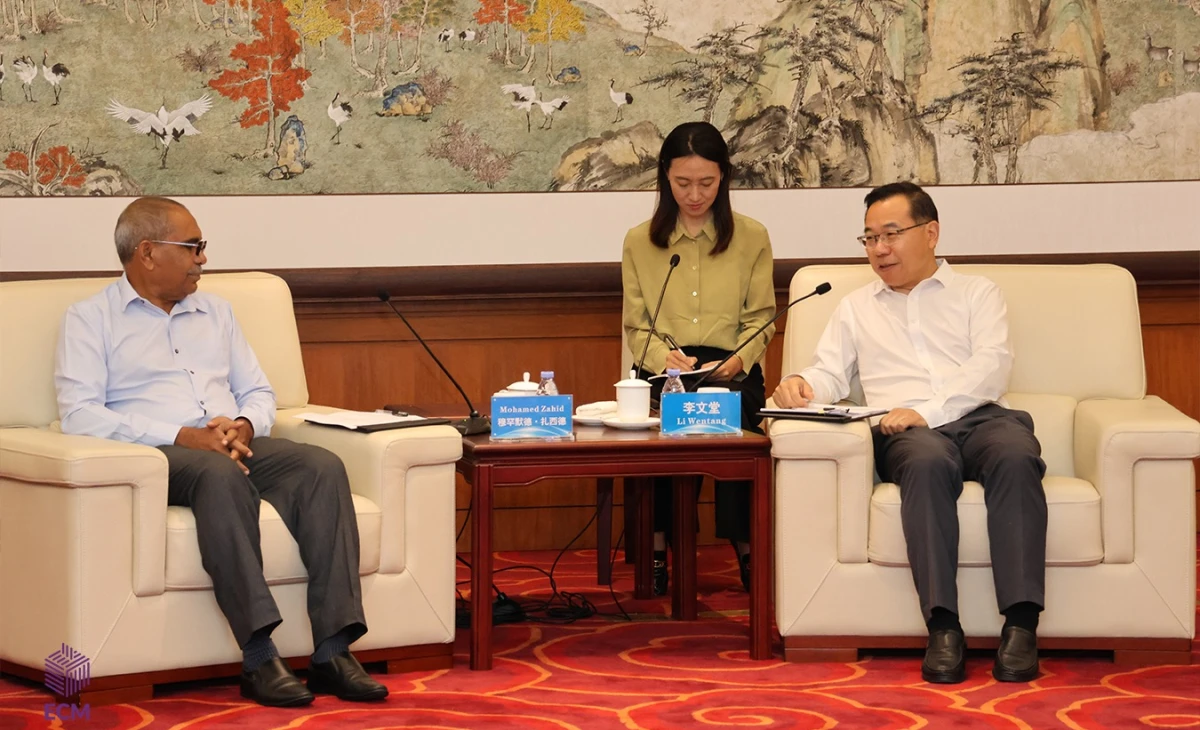
A 2025 study visit to China offered a closer look at that side of the system. The program included meetings at the Party School of the CPC Central Committee (National Academy of Governance), alongside exchanges with institutions involved in legislation, foreign affairs and community-level governance. Together, they offered a window into how China links leadership development, policy implementation and public consultation.
Public information from the Party School of the CPC Central Committee (National Academy of Governance) describes it as a key institution for training senior and mid-level officials, conducting governance research and providing policy advice, while [Beijing Administration Institute] similarly presents itself as a training and policy consultation centre for civil servants. Those descriptions help explain why these institutions attract attention from countries interested in state capacity and administrative continuity.
In the Maldives, where debates over decentralisation, service delivery and long-term planning remain urgent, the relevance is practical. China’s political system is very different from the Maldivian one, and there is no simple basis for comparison. Yet some lessons about leadership development, institutional continuity, implementation and citizen engagement are worth examining on their own merits.
Party building seen as state capacity, not just politics
One of the clearest impressions from the visit was the importance China places on what it calls “party building.” In many countries, political parties are primarily associated with elections, campaigning and competition for power. In China’s case, the CPC presents itself not only as a political organisation but also as a governing structure responsible for national development, social management and long-term planning.
At the Party School and National Academy of Governance, party building was presented as a continuous process of education, discipline, policy study and leadership preparation. Public descriptions of the institution also emphasise its role in training officials and strengthening policy capacity. It is proven that these trainings are not just ideological but administrative too: effective governance depends on institutions that are trained, organised and able to deliver over time.
Officials repeatedly stressed that legitimacy depends on understanding public concerns and responding to them effectively. That was framed not as a slogan but as an operational requirement supported by consultation, feedback and local channels of communication.
Why leadership training draws attention
One of the most striking features of the visit was the seriousness of cadre training. Rather than treating leadership preparation as an occasional exercise, the system appears designed to build officials over time through sustained education, policy study and exposure to practical governance challenges.
According to the official overview of the [Party School of the CPC Central Committee (National Academy of Governance), the institution serves as a primary platform for training officials, conducting research on major governance issues and offering policy advisory support. During discussions, training was described as spanning public administration, crisis management, law, economic policy and social governance.
The emphasis on continuity stood out. Leadership development is treated as a national investment, not a short-term fix.
Another recurring message was that policy success depends on implementation. Even well-designed reforms can fail if institutions lack the skills, systems and continuity to carry them through - a familiar challenge in the Maldives, where public debate often focuses more on promises than on execution.
Community-level governance in practice
At the Qianmen Courtyard Council, residents were shown discussing practical neighborhood issues in a setting that felt more problem-solving than ceremonial. The focus was on everyday matters - services, local conditions and community management - rather than abstract political language.
A similar point emerged at the Nanmofang Township Legislative Contact Station, where residents can feed views into broader legislative processes. The model is designed to gather public opinion on draft laws and policy proposals before decisions are finalised.
What stood out was that these mechanisms appeared legally structured rather than ad hoc. Citizen input was channeled through formal platforms with defined functions - a point that raises an obvious question in many democracies, where public consultation is often discussed but not always institutionalised in consistent ways.
An alternative understanding of democracy
Chinese officials presented the concept as one in which participation is meant to run through the full life of policymaking - from consultation and drafting to implementation and review. In this view, democracy is not measured only by periodic voting, but also by whether people have practical and legal channels to express concerns and influence outcomes.
Meetings connected to the National People’s Congress were used to illustrate how consultation is built into legislative work, with input sought from experts, stakeholders, communities and sector representatives.
Whether or not one agrees with every feature of this model, the practical takeaway for me is straightforward: policies tend to work better when the people affected by them are heard early, clearly and consistently.
International dialogue, without one-size-fits-all claims
The study visit also highlighted how China presents its governance experience to the outside world. At the International Department of the CPC Central Committee, officials said engagement with political parties from other countries is intended to encourage dialogue and exchange rather than impose a single political model.
The message from Chinese officials was that each country must develop according to its own history, culture and social conditions. This is considered an important principle: learning from another system does not mean “exporting” the Chinese system of governance but identifying practices that can be adapted sensibly to local needs.
Lessons learnt
The study visit to China offered more than a tour of institutions. It provided a chance to examine how a major country seeks to train leaders, connect legislation with public feedback, and harmonise Democratic governance with administrative governance at both local level and national level to build administrative continuity.
The central question raised is not whether observations from the visit should be idealised or dismissed. It is whether useful lessons can be drawn from what was observed. On that front, the answer is yes: institutional capacity, leadership training, structured consultation and practical local governance and continues process of party building all deserve closer attention.
Every country must chart its own course. But in an era of climate vulnerability, rising public expectations and persistent service-delivery pressures, there is real value in studying how other systems try to build capacity and stay connected to citizens.
The strongest lesson may be the simplest one: governance is not only about authority. It is about building institutions that listen, training people who can deliver, and creating systems that solve problems in ways citizens can feel in daily life.
That is a debate worth having in the Maldives - not as an argument for copying another country, but as part of a wider national discussion about what stronger, smarter and more responsive governance should look like in the years ahead.