Sat, 13 Jun 2026
|DHIVEHI


Advertisement
Sharing new opportunities in development planning: The Fourth Plenary Session of the 20th CPC Central Committee opens a new chapter for China–Maldives Cooperation
21 Dec 2025
|
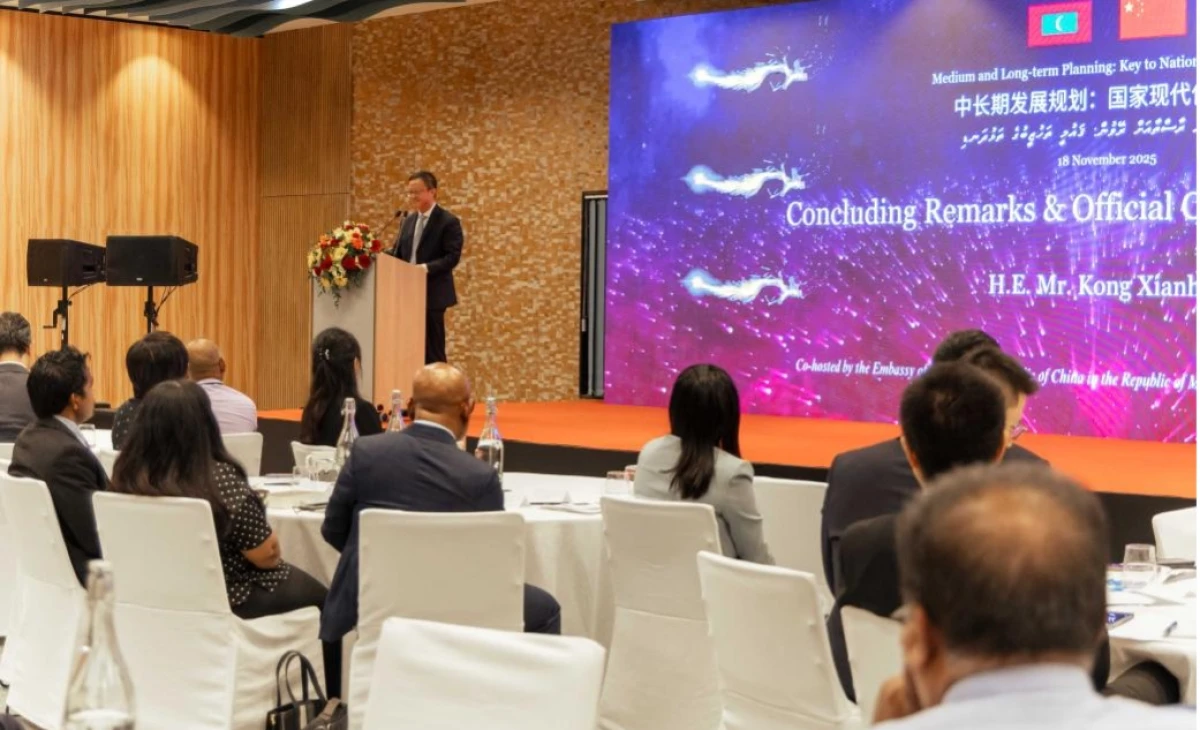
Chinese Ambassador to the Maldives Kong Xianhua --- Photo: Chinese Embassy
Facing unprecedented global changes unseen in a century, advancing national modernisation has become an important task shared by all countries. Both China and the Maldives regard medium- and long-term planning as a key instrument for guiding development. Through scientific, pragmatic and actionable planning systems, both nations set direction, define goals and build momentum for their development. This proactive approach to shaping the future is a crucial key to modernisation—and it also opens new space for exchanges and cooperation between China and the Maldives.
In October this year, the Fourth Plenary Session of the 20th Central Committee of the Communist Party of China was successfully convened. The session reviewed and adopted the Recommendations of the Central Committee of the Communist Party of China for Formulating the 15th Five-Year Plan for National Economic and Social Development. The release of these recommendations makes China’s strategic arrangements for the coming five years clearer than ever. The 15th Five-Year Plan period marks a crucial phase for the country to consolidate its foundation and make all-out efforts to accomplish its 2035 target—laying a decisive groundwork for China’s development over the next decade and beyond.
Looking back at the journey from the First Five-Year Plan to the current 14th Five-Year Plan, national planning has consistently served as an essential pillar of China’s modernisation process. From concentrating efforts on industrialisation, to resolving food and clothing shortages and achieving a moderately prosperous society, and further to becoming the world’s second-largest economy and a nation strong in innovation, China has built powerful organisational, policy-coordination and implementation capacities through sustained five-year planning. After more than 70 years of exploration, China now possesses the world’s most complete industrial system and has gradually formed a new modernisation path characterized by innovation-driven growth, green development and high-level security guarantees.
The Fourth Plenary Session set the following major objectives for the 15th Five-Year Plan period: significant achievements in high-quality development; substantial improvements in scientific and technological self-reliance and strength; fresh breakthroughs in further deepening reform comprehensively; notable cultural and ethical progress across society; further improvements in quality of life; major new strides in advancing the Beautiful China Initiative; and further advances in strengthening the national security shield. To achieve these goals, the session laid out a systematic deployment across twelve areas ranging from industrial development, sci-tech innovation and opening up to rural revitalisation, green development and national defense—forming a grand framework for China’s development over the next five years.
While the Fourth Plenary Session and the 15th Five-Year Plan map out a clear blueprint for China’s modernisation, the Maldives is also formulating its national development strategy: Resilient Maldives 2045, which aims to enable the country to reach developed-nation status and achieve independent and sustainable development by 2040. Both countries emphasise planning as a guiding force for future growth, stressing high-quality development, sustainable governance, technological advancement and the well-being of the people—creating natural synergies for cooperation in development planning.
First, in economic growth, the planning goals of China and the Maldives are highly aligned, and China’s experience offers valuable lessons for the Maldives.
The Fourth Plenary Session places “high-quality development” at the core of China’s 15th Five-Year Plan, emphasising the strengthening of the real economy and accelerating the creation of a modern industrial system—laying a decisive foundation for the next decade of progress. The Maldives’ 2045 Plan similarly aims to lay the groundwork for long-term growth as the country moves toward developed-economy status. China’s accumulated organisational capacity, policy coordination and execution experience through successive five-year plans can provide rich reference for the Maldives in formulating phased objectives, maintaining stable economic growth and achieving sustained social progress. The two sides may enhance exchanges in national planning formulation, implementation evaluation and regional development.
Second, in economic integration, China’s industrial-upgrade direction naturally matches the Maldives’ need for economic diversification.
The Fourth Plenary Session calls for fostering emerging industries such as new energy, new materials, aerospace and the low-altitude economy, while making forward-looking deployments in areas including quantum technologies, biomanufacturing, hydrogen energy, nuclear fusion, 6G communications and embodied intelligence—injecting new momentum into China’s development. The Maldives urgently needs to diversify its economy by developing green energy, the ocean economy, modern fisheries, smart agriculture and the digital economy. China’s rapid emergence in these strategic sectors complements the Maldives’ structural upgrade needs. Both sides can pursue practical cooperation in green energy, the marine economy, infrastructure and smart applications, fostering new growth engines for the Maldives while creating opportunities for Chinese enterprises to expand abroad.
Third, in scientific and technological innovation, China’s strategic investment provides strong impetus for cooperation and supports the Maldives’ long-term development planning.
The Fourth Plenary Session emphasises technological self-reliance and calls for breakthroughs in “bottleneck” technologies such as integrated circuits, basic software, high-end instruments, advanced materials and industrial mother-machines. It also promotes deep integration of innovation and industrial chains to build a forward-looking technological capability system. During the 15th Five-Year Plan, China will gain stronger global competitiveness in areas such as artificial intelligence and the digital economy. As the Maldives advances toward modernisation, it urgently needs to enhance its education, technology and innovation capabilities. Leveraging China’s strengths in talent development, scientific research cooperation and technological application, the Maldives can accelerate progress in digital governance, smart ocean monitoring, green-energy technology and other key areas—making technology a strategic pillar of its modernisation process.
Fourth, putting people first and investing in human development is a shared philosophy of both nations and forms a vital foundation for China–Maldives cooperation.
China remains committed to a people-centered approach, continually improving its public-service systems in education, healthcare, elderly care and housing, and advancing common prosperity at a higher level. As the lives of China’s more than 1.4 billion people continue to improve and its middle-income group expands, China will remain one of the world’s largest and most promising tourism markets. The Maldives currently receives more tourists from China than from any other country, and this sustained growth will provide long-term momentum for Maldivian tourism. In the future, the industry’s continued expansion will rely heavily on the vast Chinese market. Tourism cooperation between China and the Maldives holds enormous potential and will further promote people-to-people exchanges, cultural mutual learning and closer interaction—strengthening the social foundation of bilateral relations.
China–Maldives friendship has spanned more than 600 years, with deep ties between the two peoples. Going forward, the two countries should further strengthen exchanges in people-to-people, cultural and educational fields, making mutual understanding between the two peoples the most solid foundation of bilateral relations. China is willing to continue expanding educational opportunities and promote “Chinese + STEM” cooperation, enabling more Maldivian youths to study in China, acquire knowledge and skills contributing to national modernsation, and become future ambassadors of China–Maldives friendship.
On the journey toward modernisation, planning serves as the compass, and cooperation as the driving force. China’s 15th Five-Year Plan and the Maldives’ 2045 Plan together create new opportunities for cooperation, allowing both countries to unlock greater potential in their shared development. Let us seize this crucial window of strategic opportunity and work together to build a closer China–Maldives community with a shared future—opening a bright new chapter in the modernisation endeavors of both nations.