Fri, 19 Jun 2026
|DHIVEHI


Advertisement
Parliament accepts Bill seeking amendment to Employment Act
22 Apr 2026
|
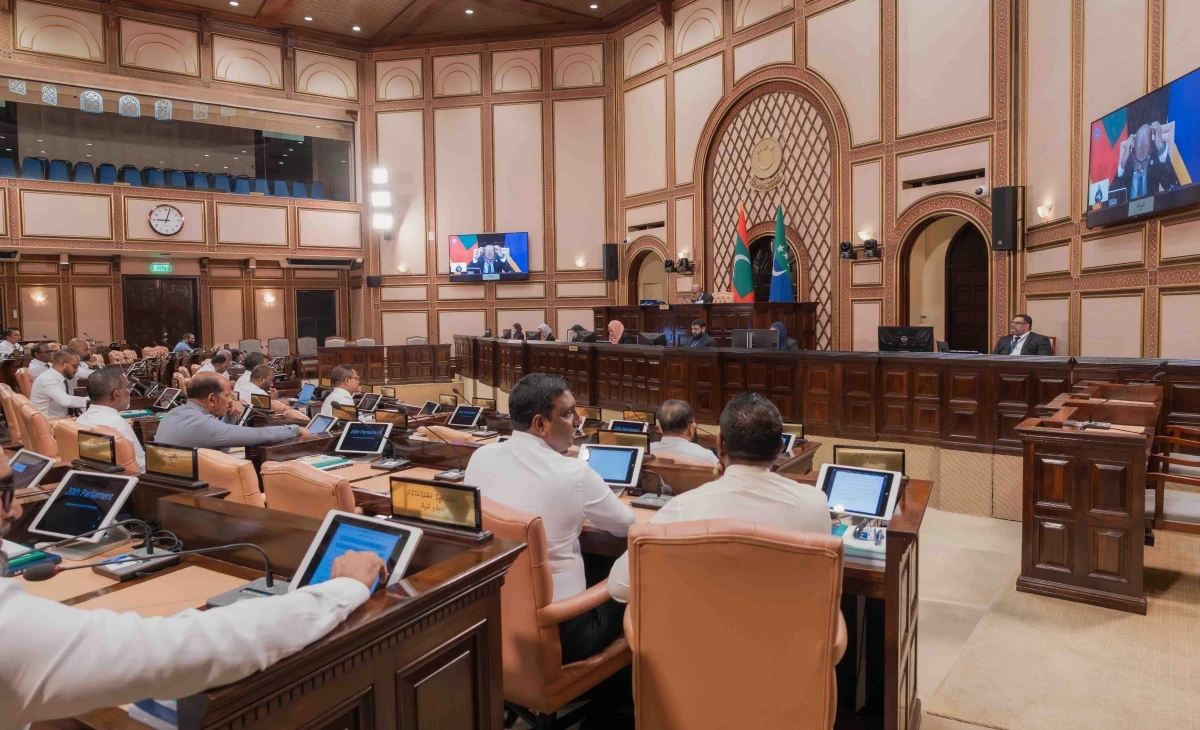
4th Sitting of First session of 2026 --- Photo: People's Majilis
A bill proposed by the Maldivian Democratic Party (MDP), seeking to amend the Employment Act to mandate that service charges for resort employees be paid in US dollars, has been accepted by the Parliament.
The bill, introduced by MDP Member of Parliament for Kendhoo constituency Mauroof Zakir, was accepted during today’s parliamentary sitting, with 67 members voting in favour, while no members voted against it.
Explaining the rationale behind the proposed amendment, the MP noted that under the current Employment Act, businesses operating in the tourism sector are required to levy a service charge of no less than 10 per cent on services provided. The law further stipulates that these service charges must be distributed equally among all employees of the establishment.
However, it was highlighted that in practice, some employers convert the collected service charges into Maldivian rufiyaa before distributing them to employees. According to the bill’s proponents, this undermines the intended benefit of the law and prevents employees from fully receiving the value of the service charges collected.
The primary objective of the bill is to ensure that employees working in the tourism sector are able to fully realise their right to service charges as guaranteed under the Employment Act.
Among the key amendments proposed is a requirement that employers must not convert service charge amounts into Maldivian rufiyaa prior to distribution. Instead, employees must be paid in the same currency in which the service charge is collected.
The bill also specifies that employees who provide direct services to tourists - whether employed on a contractual basis or through third-party arrangements - must not be excluded or treated differently in the distribution of service charges.
Following its acceptance, the bill has been referred to the Parliament’s Committee on Social Affairs for further review and consideration.